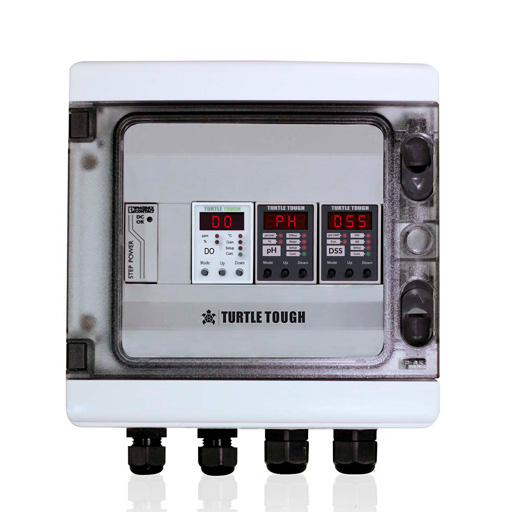
Turtle Tough industrial ORP (oxidation-reduction potential, or redox) sensors and probes measure how strongly a process oxidises or reduces, in harsh chemistry that destroys conventional probes. Every ULTRA, TOUGH and PRECISION sensor is available as an ORP version, with a platinum sensing element, a solid-state reference and digital smart output. Tell us about your process and we'll recommend one.
ORP sensors in our range
| Series | Built for | Reference and body | Chemical resistance |
|---|---|---|---|
| ULTRA Series | The most aggressive media and high solids | Kynar solid-state reference, RADEL body | Acid/fluoride, ammonia, cyanide, chlorine and sulphide gas |
| TOUGH Series | Most industrial applications | Polypropylene solid-state reference, RYTON body | Acid/fluoride and sulphide gas |
| PRECISION Series | Light-duty processes | Compact solid-state reference, CPVC or RYTON body | Selected to suit the application |
All three use a platinum ball ORP element in a low-profile tip, with a measuring range of ±1000 mV absolute (±2000 mV wide-range option). For specific processes see our application-specific sensors, and to fit an existing transmitter see OEM replacement sensors.
What an ORP sensor measures
An ORP sensor reports, in millivolts, the voltage between its platinum element and its reference. That voltage shows whether the process is oxidising or reducing and how strongly, so it tracks reactions that pH alone can't, such as how far an oxidiser has been consumed. ORP is often measured alongside pH, because many of these reactions depend on both.
Where ORP is measured
- Gold processing: cyanide destruction and leach circuits. See ORP sensors for gold.
- Water and wastewater: disinfection and dechlorination. See sensors for wastewater.
- Metal finishing and etching: chromate reduction and etch baths. See sensors for acid etching.
Keeping an ORP sensor accurate
- Never scratch or scrub the platinum element. The solid-state reference, by contrast, can be cleaned with aggressive chemicals.
- Earth the installation properly and keep the sensor away from pumps, motors and variable speed drives. Like pH, ORP is a small millivolt signal, and stray current shifts it.
- Bring the sensor up to temperature before putting it into a hot process, to avoid thermal shock.
- Our digital sensors are sealed for life, with nothing to refill. Between uses, store them tip-down with the conditioning solution in the cap.
More in sensor care and maintenance.
Frequently asked questions
Why are my pH or ORP readings jumpy or erratic?
Usually stray current or static, not a faulty sensor. pH and ORP sensors measure tiny voltages (just 59 mV per pH unit), so a small current can shift the reading a lot. Common causes are poorly earthed or shielded equipment, plastic pipework and plastic immersion rods, and nearby pumps, motors or variable speed drives.
Install sensors in metal fittings that can be properly earthed (stainless steel immersion rods rather than plastic), earth plastic pipework, and keep sensors as far as possible from high-current equipment. See installation recommendations.
What is the difference between a pH sensor and an ORP sensor?
A pH sensor measures how acidic or alkaline a solution is, using a glass membrane that responds to hydrogen ions, and reports it on the 0–14 pH scale. An ORP (oxidation-reduction potential, or redox) sensor measures how strongly a solution oxidises or reduces, in millivolts, using a metal sensing element instead of pH glass. Both use the same kind of reference system, which is why our ULTRA, TOUGH and PRECISION series come in either pH or ORP versions. Unlike pH sensors, ORP sensors can be installed at any angle.
Read about our industrial ORP sensors.
Where is ORP measurement used?
Wherever a process depends on oxidation or reduction: disinfection and dechlorination in water and wastewater treatment, cyanide destruction in gold processing, chromate reduction and other metal-finishing treatment, and chemical processes that add an oxidiser or reductant. ORP is often measured alongside pH, because many of these reactions depend on both. Tell us about your process and we'll recommend a sensor.
How do I clean an ORP sensor?
Never scratch or aggressively scrub the platinum ORP element. The solid-state reference junction is tougher: it can be cleaned with aggressive chemicals, or carefully with a sharp razor-edged tool, taking care not to touch the sensing element. Approved cleaning solutions:
- 5–15% hydrochloric acid, for alkaline deposits
- 5–15% sodium hydroxide, for organic contaminants
- A non-ionic surfactant, such as Micro-90
- 10% ammonium bifluoride
Afterwards, rinse the sensor thoroughly with deionised water to remove any cleaning residue. Always follow the safety precautions for each chemical. See sensor care and maintenance for the full procedure.